Stay · BANYAN CAMP, HAMBEGAMUWA, SRI LANKA
A floating deck under the banyan, where the lake does the parenting
Banyan Camp is reached on a road that does not behave like a road. It narrows, then forgets itself, then surrenders to a track of pale red earth that the rain has been arguing with for a decade. You park where a man tells you to park, which is under a tree, and you walk […]
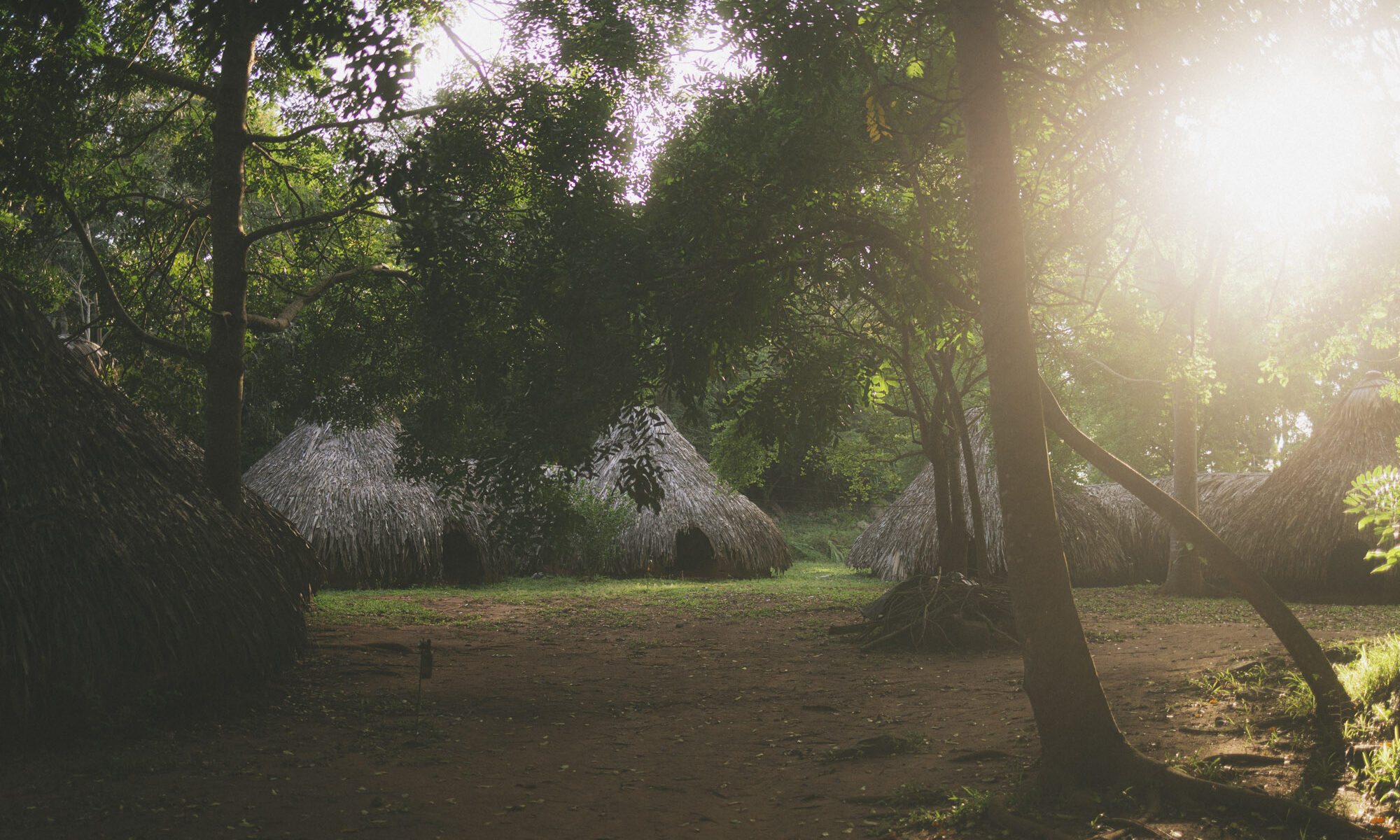
Banyan Camp is reached on a road that does not behave like a road. It narrows, then forgets itself, then surrenders to a track of pale red earth that the rain has been arguing with for a decade. You park where a man tells you to park, which is under a tree, and you walk the last stretch on foot. By the time the thatched roofs come into view through the trunks, the children have stopped asking how much further. They have understood, before we did, that this is the kind of place that wants to be approached slowly.
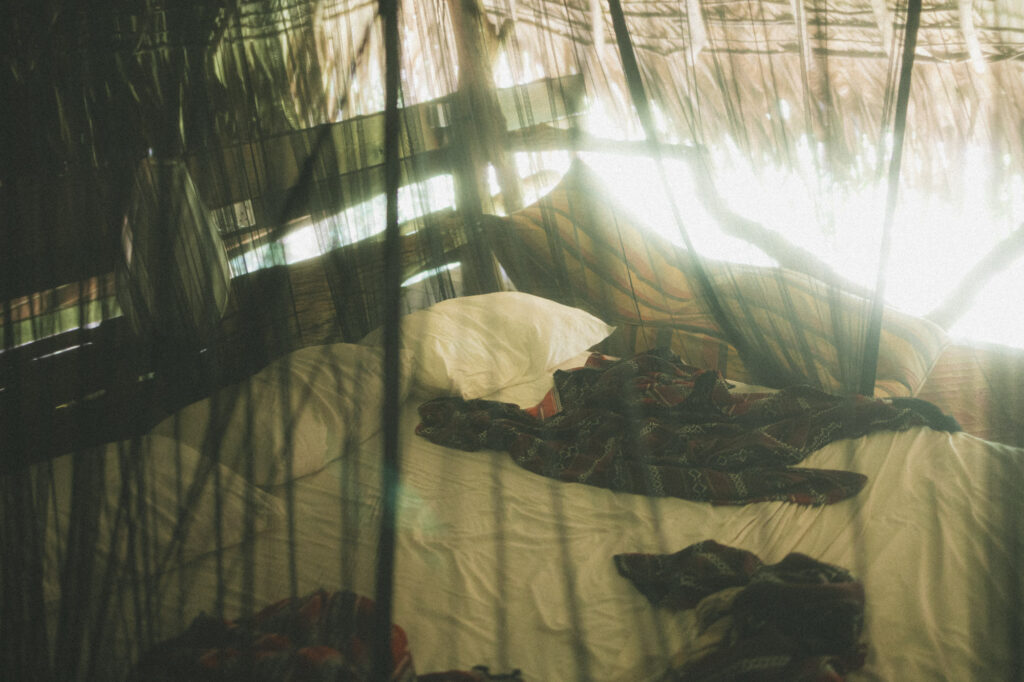
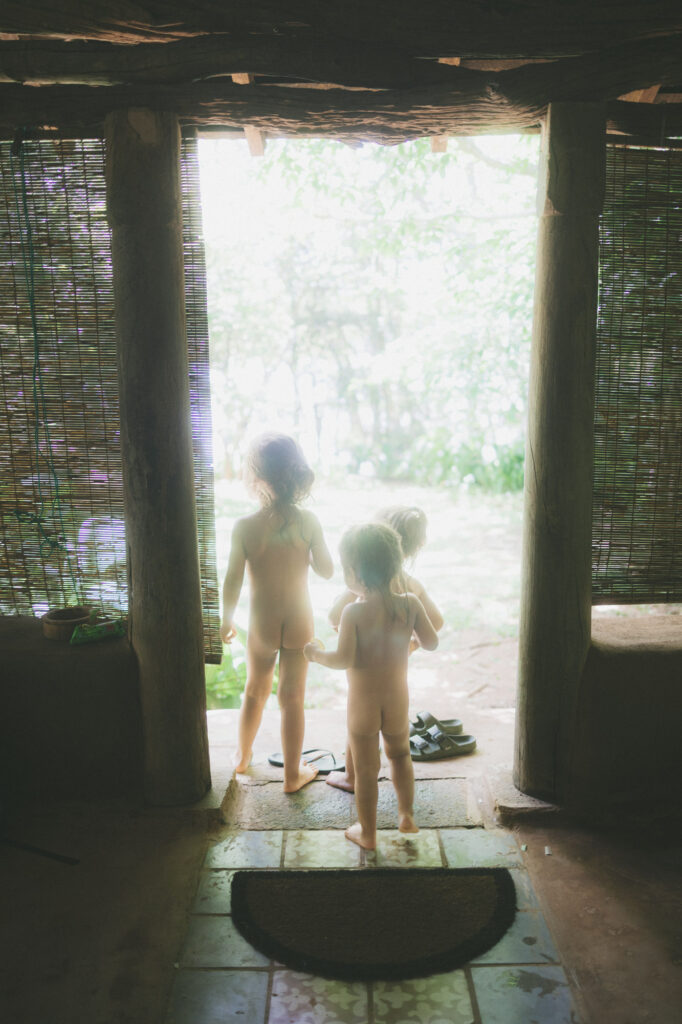
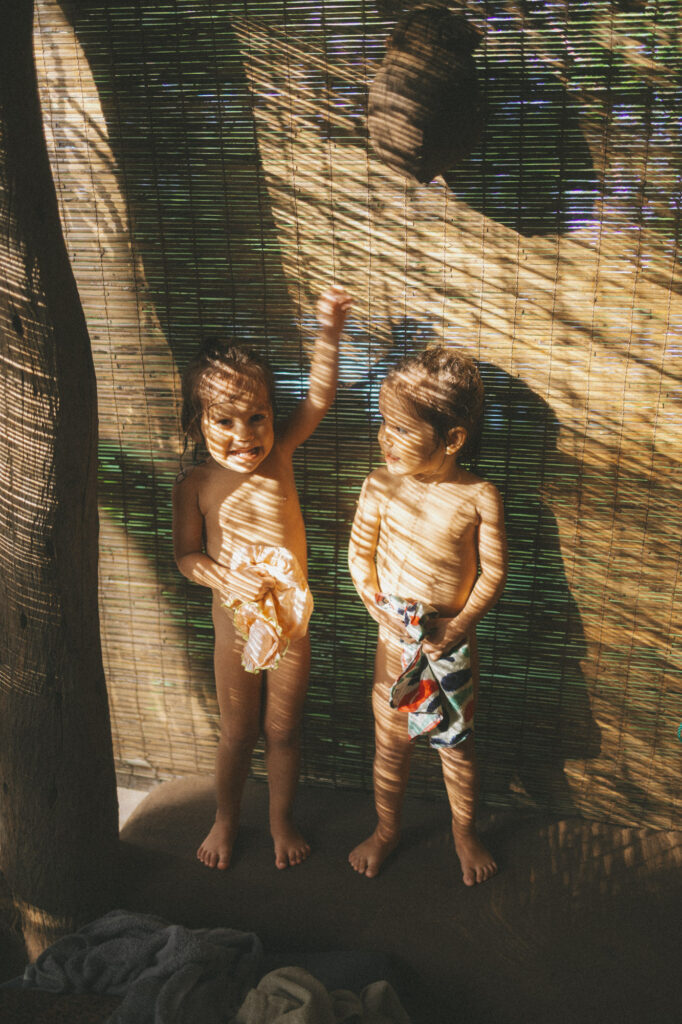
There are six huts in a loose horseshoe around a clearing, each one a small cone of woven palm with mud-rendered walls and a doorway low enough that you remember you have a body. No keys. No glass. A bamboo blind that you roll down at night and a mosquito net the colour of weak tea. The first thing our seven-year-old said, standing barefoot on the cool floor of ours, was: it smells like the inside of a basket. She meant it as a compliment, and she was right.
The brief
We had been told about Banyan Camp by a woman in Galle who runs a small ceramics studio and travels with two children of her own. She said it the way people say the names of restaurants they don’t quite want you to know about. Beautiful, she said. Properly off-grid. Bring a torch. Don’t bring anything you mind getting wet. The kids will be feral by the second morning and you will not be able to do anything about it. We took notes.
There is no wifi. There is no plug socket in the hut. There is a kerosene lamp on a low table, and a box of long matches, and the assumption that this is enough.
What we had not been warned about was the lake. The huts sit on the inland edge of a freshwater lagoon ringed by half-submerged trees — a flooded forest, really, the kind of place a heron would design for itself if a heron were given a budget. The water is shallow for thirty metres out and the bottom is firm sand. Our two-year-old waded into it on the first afternoon and stayed there, with her father beside her, until the light went orange and someone called us in for tea.
The architecture
The huts were built by a local carpenter who has been working on the property for twenty-one years. The structure is teak salvaged from old houses in the next village, lashed with coir rope, and roofed with iluk grass cut on the property each January. There is no concrete anywhere. The floor of our hut is a polished mud-and-cow-dung composite that the camp re-finishes every six months by hand. It is cool underfoot at every hour of the day, including the hour when our four-year-old decided to sleep on it instead of the bed.
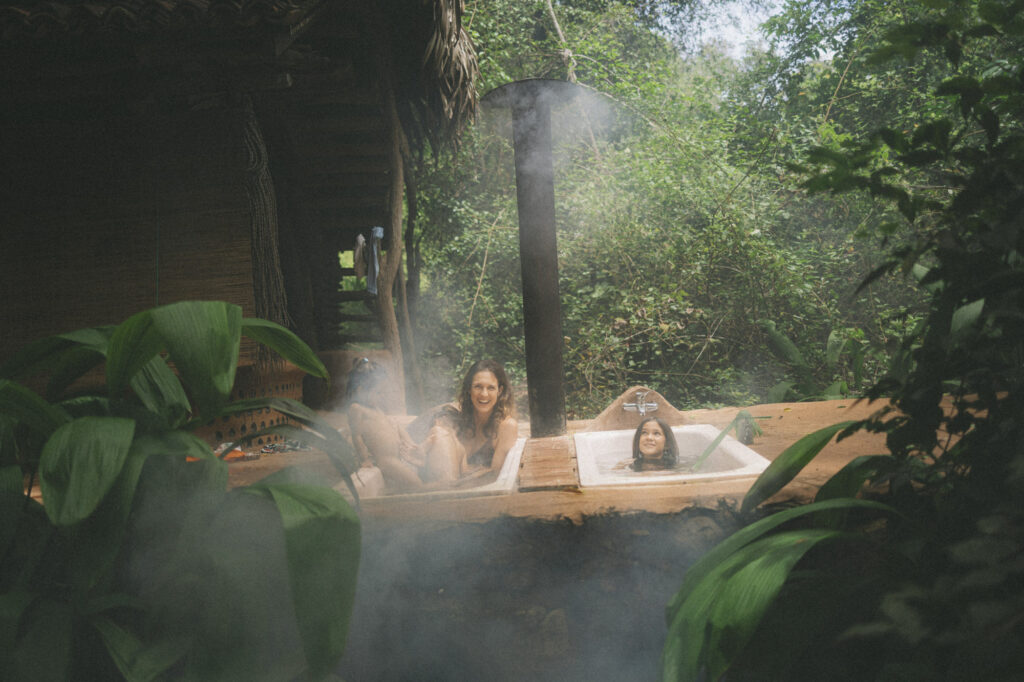
The bathroom is outside, behind a half-wall of woven reed. A copper tap, a stone trough, and a wood-fired bathtub set into a platform of raw teak. The fire is lit at five by a man named Sunil who appears, fills the chamber, and disappears again, leaving the water to climb slowly to the temperature of a held hand by sundown. Our older daughters sat in it for an hour with their mother. The youngest watched from the doorway with a banana.
The deck
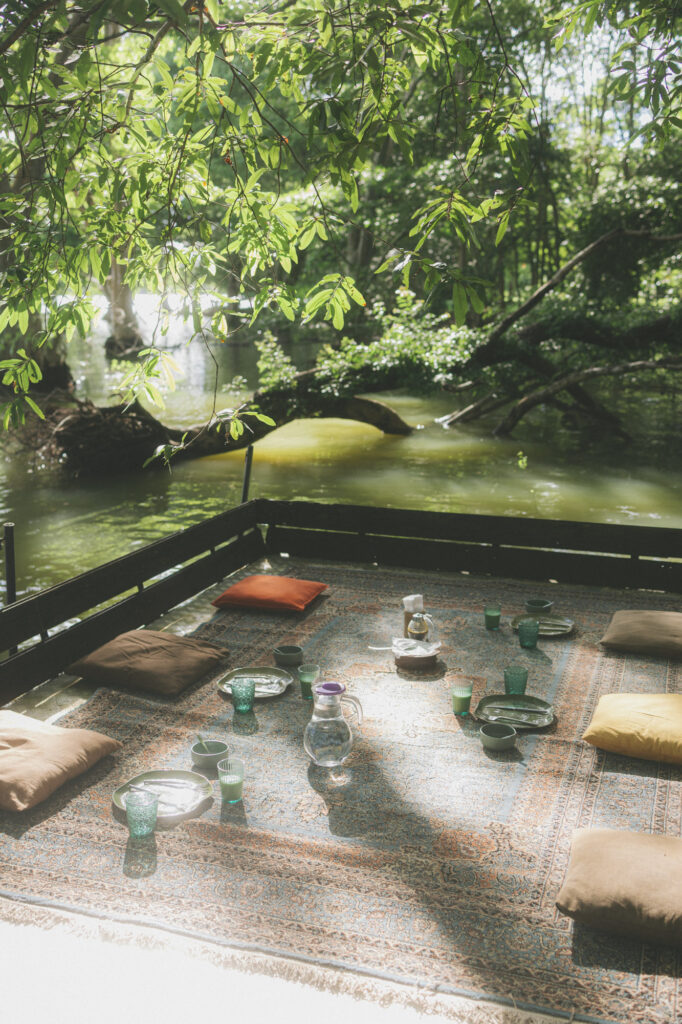
Meals are taken on a wooden platform that floats — actually floats, on lashed barrels — at the edge of the lagoon, shaded by a banyan that is plausibly older than the country itself. A carpet, six cushions, low brass jugs of water with a slice of lime in each. Curries served in green glassware that is the exact colour of the leaves above us. We ate every meal there for four days. The children ate with their hands, which is what everyone else was doing, so no one minded.
On the second morning a peacock walked across the deck during breakfast. He did not stop. He did not look at us. He went to the far end, considered the water, and left again the way he had come. The children watched him without speaking. This is the closest any of them have come, in their entire lives, to a religious experience.
What it actually costs
It costs comfort, in the specific narrow sense that the word is used in hotel marketing. There is no air conditioning. The bed is a foam mattress on a teak platform, firm in the way a floor is firm. The light at night is what the lamp gives you and what the moon gives you, and on the third night, when the moon was new, the answer was almost nothing. We loved it. Whether you will love it is a question only you can answer, and probably not until you are standing in the doorway of the hut at ten at night holding a flashlight and a small, sleeping child.
Request these dates
More from the magazine
Experiences · Rama Shala, Harumalgoda, Habaraduwa, SRI LANKA
The place we built so that families like ours would have somewhere to land.
Rama Shala is where we live. It is also where we welcome families who want the same thing we wanted when we started travelling with children — a beautiful, unhurried place where the parents can breathe and the children can run.